


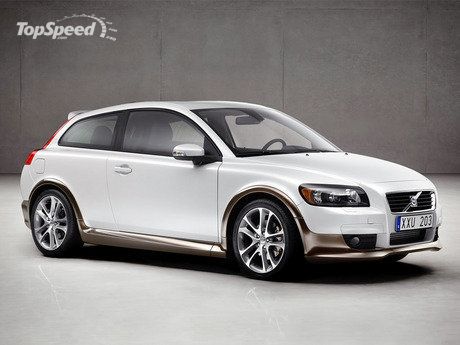
2010 Volvo C30

2010 Volvo C30

2010 Volvo C30

2010 Volvo C30

 With a more aggressive nose and its fastback roof line, the slippery 4-door coupe would be a very welcome successor to the oh-so-bland S80. Something like the S90 could help Volvo reinvent itself as truly stylish, mid-range luxury in order to tackle the world.
With the new S60 sedan already poised to fight the 3-Series, a car providing CLS looks at an E-Class price is definitely going to be necessary for Volvo to keep its momentum going.

Coming in at a starting point of $38,550 ($37,700 plus $850 for destination charges), the new S60 hopes to pull in buyers from the mainstays. BMW, Mercedes, Audi, and Lexus? Volvo wants to take them down to China Town.

 See, the Swedes wanted to show journalists how the 2011 S60 sedan's new 'Collision Warning with Auto Brake' system works in action, so they catapulted a test car out of a tunnel at around 35km/h towards a parked truck.
Volvo says this about the system: "Volvo's new Collision Warning with Auto Brake automatically brakes the car if there is an imminent risk of a collision with a moving or stationary vehicle. The system starts by alerting the driver and preparing the braking system for emergency braking. If the driver does not respond despite the warning, the brakes are applied automatically."
 For the 2011 model year, Volvo is introducing a new five-cylinder 2.0-litre turbo diesel that will be available throughout its range while the Swedish automaker also upgraded the six-cylinder petrol engines offered on the S80, V70, XC70 and XC60.
The new five-cylinder diesel unit is in principle the same engine as the 2.4-litre diesel, but its displacement has been reduced (with a shorter stroke) to 2.0-liters. It will be offered in three different variants in terms of output.

Designer Patrik Palovaara says, "It's true that truck design is largely about rational factors like aerodynamics and ergonomics. But there's also an emotional dimension. The truck's appearance is strongly linked to both its function and its identity and, by extension, to its brand."


The new race car gets a revised front end which is longer, lower and wider, with the Swedish automaker claiming that the new design delivers a higher ground pressure at the front, and an improved airflow right around the vehicle.

At launch, the new S60 will be available with a choice of two diesels and one petrol engine. The newly-developed five-cylinder 2.0-liter D3 diesel engine produces 163HP and 400Nm of torque returning a combined fuel economy of 54.3mpg UK.

The new S60 racer was developed locally by Volvo's Belgian S60 Racing Team in accordance with the BTCS Silhouette S1 regulations. All cars participating in the series must use a tubular chassis, the same type of front and rear suspension and aerodynamics.

The idea behind the project is to create the ultimate C30 without being halted by specific race regulations. The concept includes a 400-horsepower engine, all-wheel-drive, and aerodynamics based on Polestar's race car data.

According to Autonews, Li was referring to Volvo's dependence on Europe for production and Europe and North America for the most part of its sales.
Geely's chairman believes that this issue will be solved by building a factory in Beijing, China, that will make 300,000 Volvo cars a year, or about the same amount the automaker currently produces at its plants in Sweden and Belgium

The Detroit company said that the transaction will be made in the form of a note in the amount of US$200 million and the remainder in cash.
 It's worth noting that Geely has acquired Volvo at a fraction of what Ford paid for the Swedish automaker at $6.5 billion in 1999.
Ford said that even though Geely owns 100 percent of Volvo, due to the fact that the Swedish automaker's cars share core components and technologies with its own vehicles, it will continue to supply the company with powertrains, stampings and other vehicle components for an undefined period.
 A revista britânica “What Car?” elegeu o Volvo S40 1.6D DRIVe como o carro ambiental do ano.


Some things just get better all the time.
“I’m very pleased and proud to introduce the new Volvo XC90 D5. It has all the features and benefits that are renown in a XC90 model - safety, versatility, spaciousness and stylish too… and now with the diesel variant, things just got even better,” said Mr. Robert Norrman, President of Volvo Car Malaysia.
Since the launch of the petrol engined XC90 T5 and T6 in 2003, the first 7-seater luxury SUV in
“Malaysians are absolutely right to choose the XC90 as their car of choice. Its features, benefits, safety, price… the whole package is just superb,” said Norrman.
The locally-assembled XC90 D5 is a transversely-mounted 2.4 litre in-line 5-cylinder turbocharged engine producing 185 horsepower and 400 Nm of torque with a 6-speed automatic Geartronic transmission.


More background of the Volvo XC90:
Launch
The Volvo XC90 was launched in early 2002 as the first purpose-built SUV (Sports Utility Vehicle) to come from Volvo Cars. It is also Volvo's first seven-seat car since the 1940s. The Volvo XC90 has electronically controlled
New features Volvo XC90 - brief summary
· Exterior rear emblem with increased space between the letters
· Modified front head restraints
Design
Five-door SUV - a crossover model that combines the passenger car's comfort and comfort with excellent get-you-there ability and flexibility. The Volvo XC90 is designed to give a robust yet at the same time compact and elegant impression. It is built as a 7-seater passenger car, with a unitary body and the same type of chassis as that found in Volvo's sedan models - unlike some other SUV models that are built on a truck chassis. The passenger compartment is very spacious, thanks not least to Volvo's modern powertrain concept with transverse engine installation.
The Volvo brand name in the rear of the XC90 D5 adopts the new widespread lettering to enhance visibility of the brand. The individual letters will also be larger.

Safety
Volvo Cars adopts a holistic view of safety that encompasses both Preventive and Protective safety. Preventive safety is closely linked to the car's driving properties. The body of the Volvo XC90 features immense torsional rigidity and the car has a sturdy chassis, a combination that results in consistent, predictable behaviour on the road. Ground clearance is high to offer good get-you-there ability on poor roads. Despite this, the floor is set low down, which contributes to the car's low centre of gravity and excellent directional stability.
Protective safety in the Volvo XC90 is structured around a network consisting of exterior and interior safety systems that interact with one another to reduce the risk of occupant injury in a collision.
The exterior systems have the task of distributing and absorbing incoming collision forces so that the passenger compartment remains as intact and undamaged as possible.
Thanks to its unitary body, the Volvo XC90 has been able to be built with the same type of deformation zone as Volvo's other car models. The body is built in the form of a metal cage where all the components interact with one another to ensure controlled deformation. A gently rounded front and an extra beam below the front bumper help reduce the risk of injury to other road users.
The interior safety systems aim to keep the passengers securely in place and also to reduce the risk of serious injury. In order to provide the most effective protection possible, Volvo Cars has developed a number of in-house systems, such as WHIPS (Whiplash Protection System), SIPS (Side Impact Protection System) and IC (Inflatable Curtain). All are fitted as standard in the Volvo XC90. Certain components have undergone further development specifically for the XC90 model. For instance, the Inflatable Curtain has been extended so it also covers passengers in the third row of seats. All seven seats are equipped with three-point inertia-reel seat belts, belt pre-tensioners and head restraints. The highest possible safety requires that all the car's occupants always use their seat belts.
The Volvo XC90 features reinforced roll-over protection. An active stability-enhancement system (Roll Stability Control) activates if the car risks rolling over. Engine power is reduced, anti-roll bar stiffness is increased and the brakes are automatically applied to stabilise the car. If the car should roll over, a network of beams in the body structure helps distribute and absorb the resulting forces. In addition, an electronic sensor registers if the car is about to roll over and accordingly activates the seat belt pre-tensioners and the inflatable curtains.
Driveline and handling
The Volvo XC90 D5 is equipped with a five-cylinder engine. It is fitted transversely in keeping with Volvo's modern powertrain concept. They are designed to operate smoothly, with low vibration and high torque across a wide rev range.
The engine is extremely compact and mounted transversely, for optimum crash safety and maximum cabin space.
The chassis, with spring struts at the front and Multilink axle at the rear, is set up for stable, reassuring driving manners and alert steering response. The Multilink rear axle is an independent rear suspension system featuring a number of links and it is designed to offer a good combination of controlled wheel movements and high ride comfort. Some of these links have the task of providing a certain degree of anti-skid steering effect. A long wheelbase and wide track, together with a very torsionally rigid body, contribute to the predictable, controlled driving manners. Large wheels with a relatively tall tyre profile and stiff tyre sidewalls contribute further to stability.
The Volvo XC90 has Volvo's electronically controlled
The environment
The Volvo XC90 is designed and equipped to impact as little as possible on the global environment and to offer a clean and healthy interior climate. Energy-efficient diesel engines with particle filters produce low emissions of carbon dioxide and soot particles.
Volvo's IAQS (Interior Air Quality System) effectively reduces the amount of particles, pollen, gases and certain unpleasant odours in the air entering the cabin. In addition, all textiles and leather are certified under ÖKO-TEX 100, an international standard, which ensures that the interior trim is free from allergy-inducing substances and emissions.

 Com o hatch C30, a Volvo tem conseguido números de vendas muito respeitados em todo o mundo, inclusive, por que não, no Brasil. E como de costume, quase sempre as marcas planejam versões especiais dos modelos que estão de bem com os números.
 Volvo has released the first photos of its freshest new model: the all-new 2009 Volvo XC60. "This is not only the safest Volvo ever - it's also the most stunning," says Volvo Cars President and CEO Fredrik Arp. The new XC60 will debut at the Geneva Motor Show on March 4, 2008. Its U.S. launch following shortly thereafter; the first quarter of 2009.

 Volvos' new XC60 crossover steps boldly into what is the motoring world's toughest and fastest-growing segment - the "Small Premium Utility". This car is charged with more emotive form and more energy than any other Volvo," says Volvo Cars Design Director Steve Mattin. "We're elevating our design DNA to an entirely new level by literally turning up the visual volume. If you say that you'd recognise a Volvo from 300 feet away today, I dare say the XC60 radiates a clear Volvo presence from at least twice that distance."

 A variety of intelligent safety systems are another important part of the XC60's special character. The big news is City Safety - a unique system that can help the driver avoid or reduce the effects of the type of low-speed impacts that are common in city traffic. If the car is about to drive into the vehicle in front and the driver does not react, the car automatically applies the brakes.

 The new XC60 will be launched in the U.S. with only one standard engine: the powerful turbocharged T6, which produces 281 horsepower. All Wheel Drive (AWD) with Instant Traction is fitted as standard. The global sales target for the new XC60 is 50,000 units per year. The five largest markets during the peak year 2010 are expected to be the USA (15,000 - 20,000 units annually), Germany, Great Britain, Russia and China.
 The Volvo XC60 will be built at the Volvo Cars factory in Ghent, Belgium. Sales will start in Europe during Q3 2008, while sales in North America are targeted to begin in early 2009.


 The 'basic' S80 is the 2.5L turbocharged 5-cylinder with 200bhp @ 4800rpm and 300Nm @ 1500-4500rpm, mated to a 6-speed Geartronic auto 'box. Claimed performance figures are 8.0secs from 0-100km/h and top-end is 210km/h.
 Higher up is the all-aluminium 3.2L inline-6 (as pictured above) capable of 238bhp @ 6200rpm and 320Nm @ 3200rpm. The extra horses enable this locally top-of-the-line S80 to achieve a higher Vmax of 240km/h, while the century dash is a hair-breadth's quicker at 7.9secs.


 The locally-assembled S80 2.5T is priced at RM268,500 while the fully-imported S80 3.2 goes for RM398,000.

|
|---|


